How Team Games Build Collaboration in Middle School Math
Middle schoolers will talk to each other no matter what. Team games turn that talk into math talk, and the explaining is where a lot of the learning happens.
Short answer: interactive team games improve collaboration in middle school math because the team has to agree on an answer before it counts. Students explain their thinking, catch each other's mistakes and teach the step a teammate missed. With small teams, a turn order that rotates and a rule that anyone can be asked to explain, every student contributes, not just the fastest one.
Why team play builds math talk
- A shared stake. When the team wins or loses together, students care whether their teammates understand.
- Explaining is learning. Students who explain a step to a teammate understand it better themselves.
- Mistakes get caught early. A teammate questioning an answer is faster feedback than a graded worksheet a day later.
- Lower stakes for quiet students. A wrong idea said inside a team is less scary than one said to the whole class.
How to set it up so everyone plays
- Keep teams small. Three or four students is enough for discussion without anyone hiding.
- Rotate the writer. A different student writes or enters the answer each turn.
- Anyone can be asked "why?" Pick a random teammate to explain before you accept an answer.
- Mix the teams. Put students with different strengths together and change teams every few weeks.
- Debrief the hard ones. After the game, go back to the problem that caused the biggest argument.
Game features that help
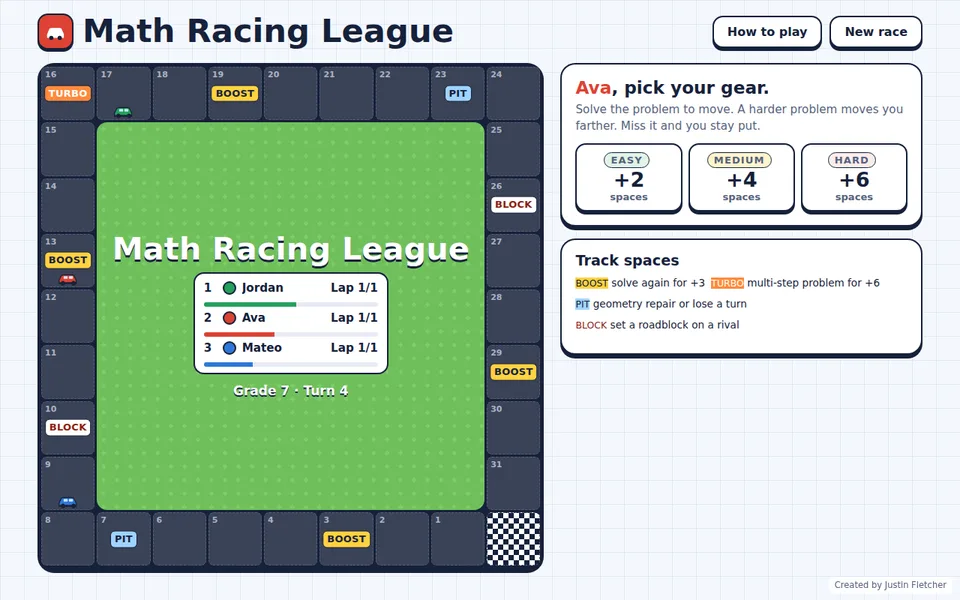
- Choices. Picking an Easy, Medium or Hard problem gives teams a decision to talk through.
- Steals. When a missed problem passes to the next team, everyone keeps working on every problem.
- One shared screen. Everyone sees the same board, so the whole room follows the game.
Team games for middle school math
Every Fletcher Math game is built for 1 to 6 players or teams on one shared screen, runs offline and needs no student logins.
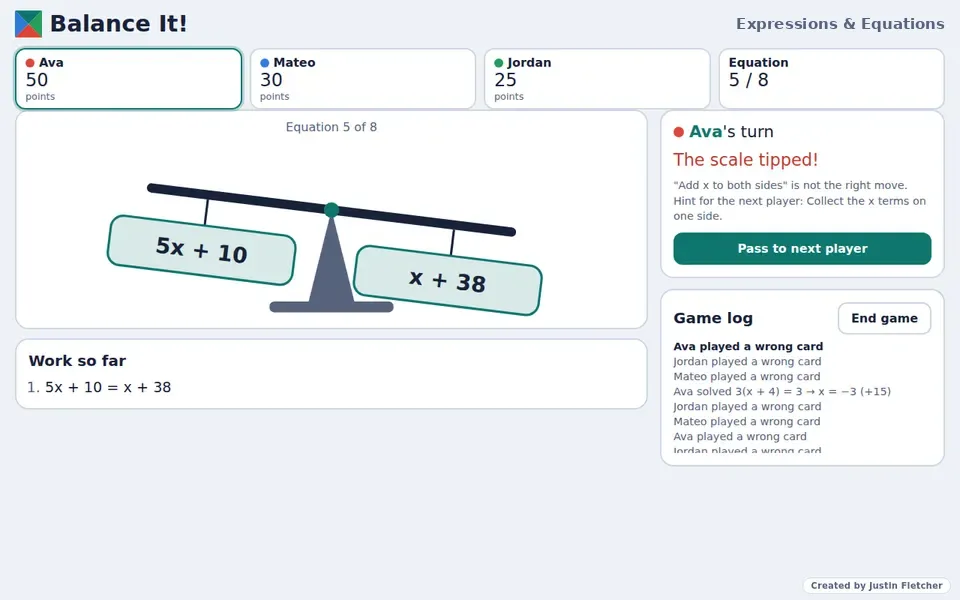
- Balance It!: solve equations by keeping the scale balanced. Miss a step, and the next team can steal it.
- Math Racing League: choose an Easy, Medium or Hard problem to move 2, 4 or 6 spaces.
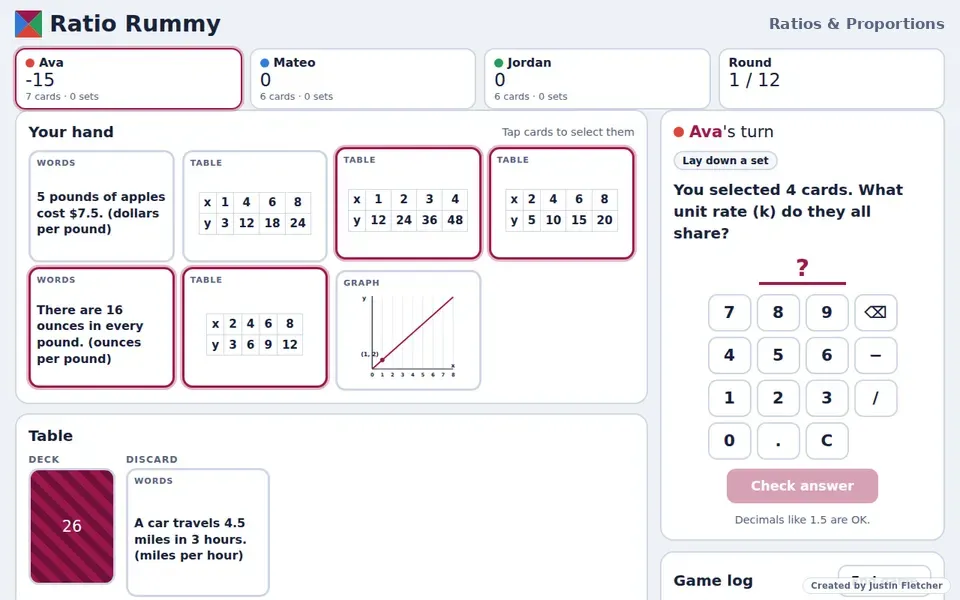
- Ratio Rummy: match tables, graphs, equations and word cards with the same unit rate.
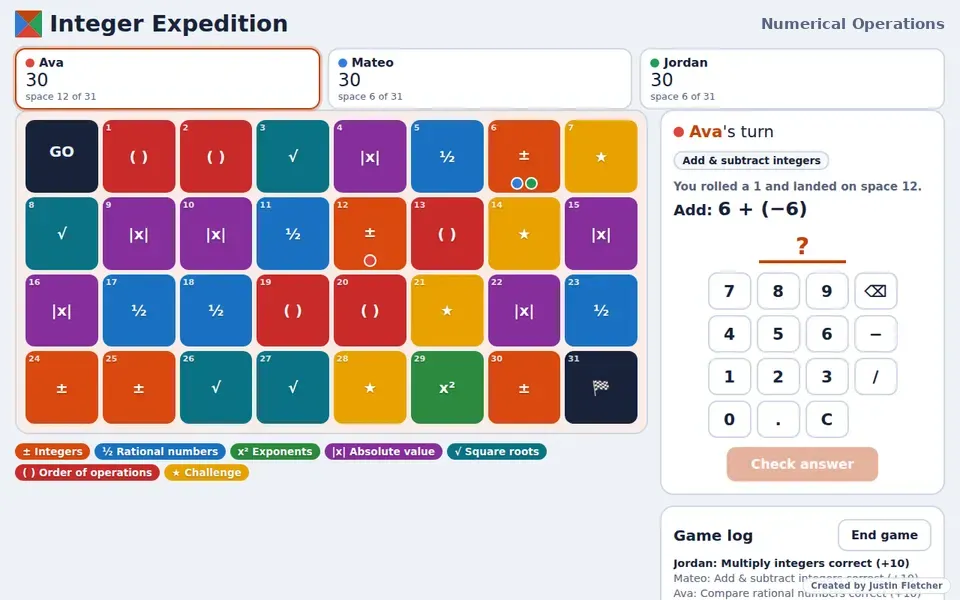
- Integer Expedition: integers, rational numbers, exponents and order of operations on a race trail.
- Turf Takeover: 7th Grade Math Review: a team review of every 7th grade standard where teams claim and steal tiles.
More: 6th grade, 7th grade and 8th grade math games.
Common questions
How many students should be on a team?
Three or four works well. With up to 6 teams on one screen, that covers a class of about 24.
What if one student does all the work?
Rotate who enters the answer each turn, and ask a random teammate to explain before you accept it.