Math Games for Quick Brain Breaks (5–10 Minutes)
Those leftover minutes at the end of a period add up to hours over a year. A good brain break resets attention and sneaks in practice, instead of turning into free time that's hard to rein back in.
A brain break game has to start fast and stop cleanly. If it takes five minutes to set up or leaves students upset that it ended, it isn't a brain break. Here's what works in a short window.
What makes a good 5 to 10 minute game
- Starts in under a minute. Open the file, pick teams and a grade, press Start.
- Every turn is short. One problem, one answer, next team.
- You can stop anytime. Whoever's ahead when the bell rings wins.
- Light on reading. Quick number problems work better than long word problems in a short break.
Brain breaks that get kids moving
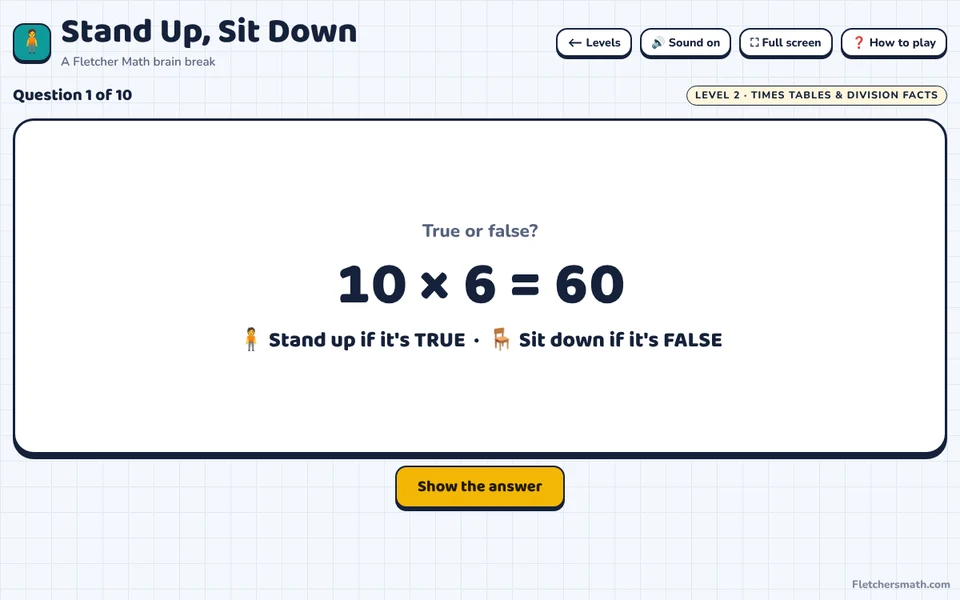
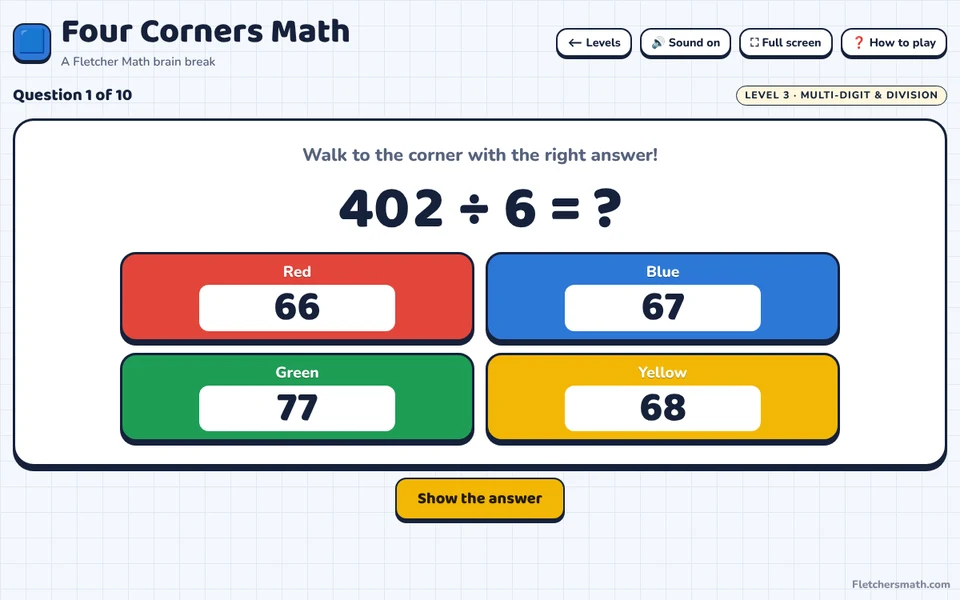
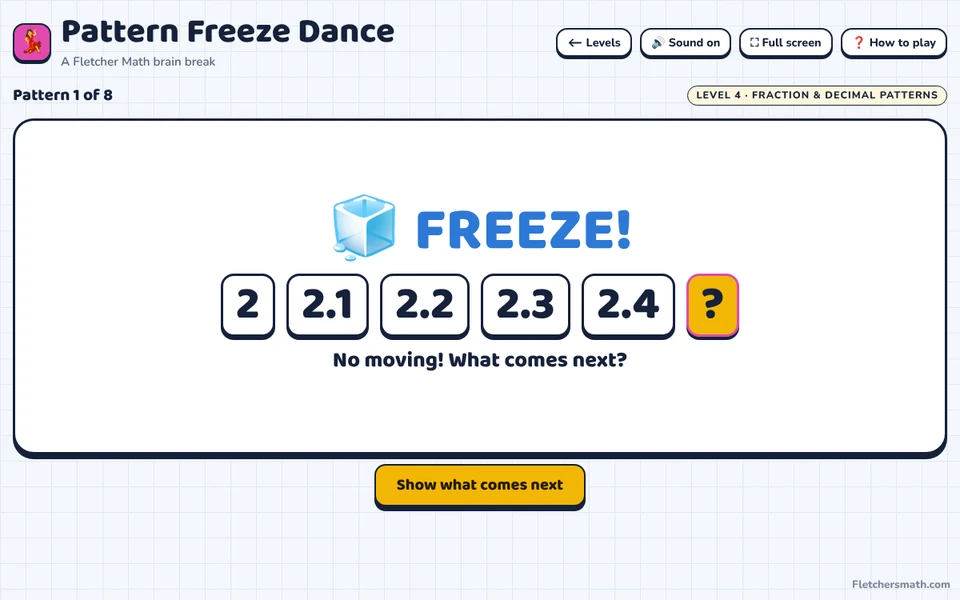
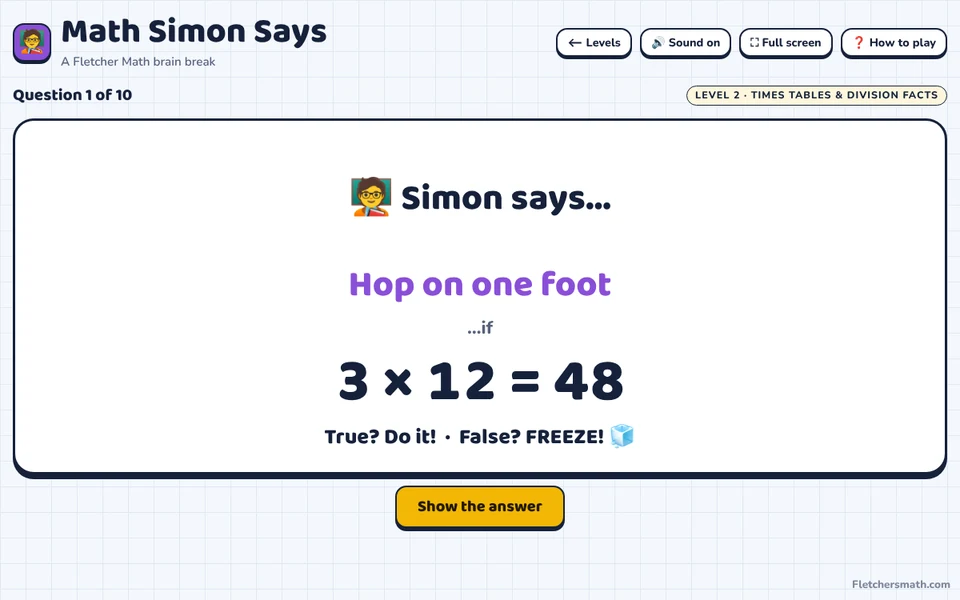
The math brain break games are made for exactly this window. The whole class plays on the projector while they move, a round takes 2 to 4 minutes, and every game has 5 levels from adding within 20 up to integers and one-step equations.
- Stand Up, Sit Down: Stand if the math sentence is true, sit if it's false.
- Four Corners Math: Walk to the corner of the room with the right answer.
- Pattern Freeze Dance: Dance while a pattern builds, then freeze and call out what comes next.
- Math Simon Says: Do the move only if Simon says it and the math is true.
Quick games to keep ready
- Krypto (grades 3–8): Five number cards, make a true equation. One round is a great two-minute puzzle for the whole class.
- Double Trouble (grades 1–4): Doubles, halves and near doubles for faster mental math.
- Who's Multiplying? (grades 3–5): Fast multiplication facts with a 4-in-a-row board.
- Number Line Treasure Dive (grades 3–8): Tap the number line to land on the right spot: whole numbers, fractions, decimals and negatives.
- Math Magic (grades 3–8): Place tiles so colors match and score the math on every matching side.
- Scale Sleuths (grades 3–8): Balance-scale logic puzzles. One puzzle fits nicely in a short break.
Games with 4-in-a-row boards
Games like Graph Garden, Cube Quest, Shape Sorter and Bell Curve Bingo use a 4-in-a-row board. They're easy to explain, and a round can end as soon as someone connects four, which makes them a natural fit for the end of class.
Tips for keeping it a break
- Keep the game file on your desktop so it opens with one click. Fletcher Math games work offline, so there's nothing to load.
- Use the same two or three games all month. Students learn the rules once and you skip the explaining.
- Set a timer and announce the last turn before it ends.
Every game has a free demo, and the demo itself makes a nice 5-minute trial run: find one for your grade.
Common questions
Can I use these with no prep?
Yes. Download the game once, then double-click it whenever you have a few minutes. There's nothing to set up and no student logins.
Are there brain break games for younger kids?
Yes. The math brain break games start at adding within 20, and Double Trouble, Odd Socks, Counting Critters and Fact Fiesta are made for the early grades.