How Standards-Aligned Games Boost Engagement in Science Class
Science vocabulary and concepts pile up fast, and review days can turn into flashcard drills. A good game turns that review into something students want to do, but only if it practices the standards you're teaching.
Short answer: interactive, standards-aligned games raise engagement in science because students have to use the concepts to make progress: placing organisms in a food web, deciding which force wins, or choosing which element completes a reaction. When the game is written to your NGSS performance expectations, that engagement turns into practice on exactly what you're teaching, instead of a fun break from it.
Why games work for science
- Science is full of systems. Food webs, circuits and the water cycle are about how parts affect each other, and a game board can show that better than a list of definitions.
- Vocabulary sticks when it's used. Students remember "producer" and "decomposer" when they need them to win a turn.
- Teams argue about evidence. When a team has to agree on an answer, students explain their reasoning, which is the habit NGSS asks for.
- Review stops being a chore. A team review game covers the same content as a study guide, with far more students paying attention.
What to check in a science game
- It names the standards. Look for NGSS codes such as 3-LS2-1, not just "life science."
- The science is how you play. Correct thinking moves you forward. A trivia question between unrelated turns doesn't count.
- It fits your grade band. Elementary, middle school and high school science ask very different things.
- It runs in your room. A game that needs no logins and no internet won't fail on a bad WiFi day.
Where games fit in a science unit
- After the lab or lesson, to practice the vocabulary and ideas students just met.
- As a mid-unit check, where team discussion shows you which ideas are still shaky.
- On review day, before the unit test or the state science test.
- As a brain break, with a short movement game that still uses science content.
Science games from Fletcher Math
Fletcher Math has science games for kindergarten through high school. Every game runs offline on one shared screen for 1 to 6 players or teams, needs no student logins, and lists its NGSS standards.
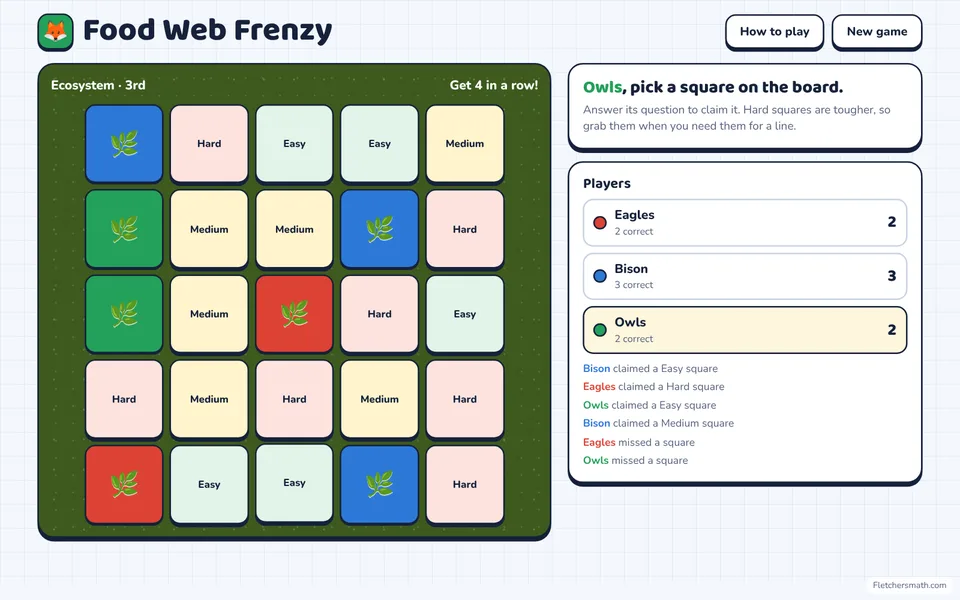
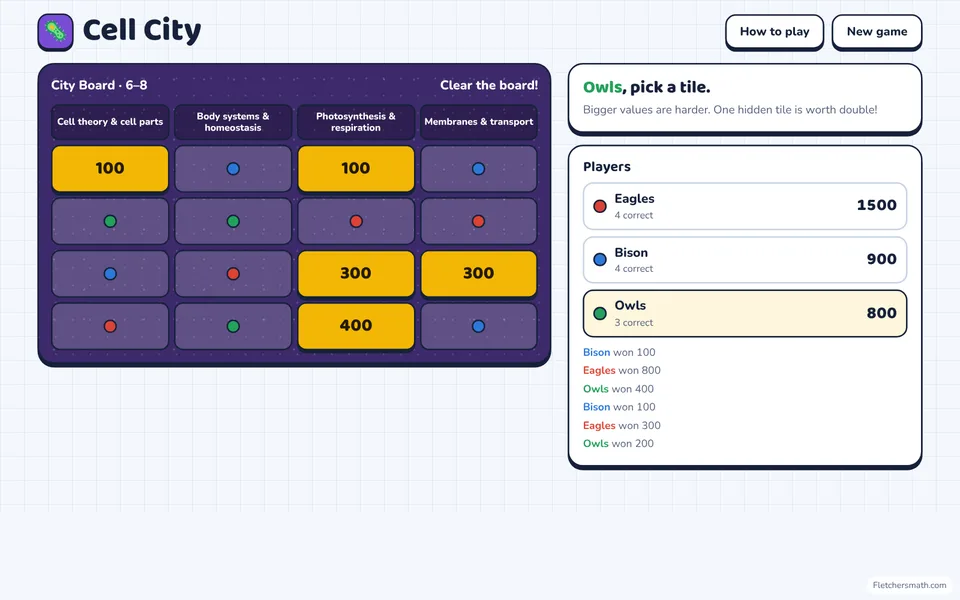
- Life science: Food Web Frenzy (producers, consumers, decomposers and adaptations, grades 3–8) and Cell City (organelles, body systems and DNA, grades 6–8 and Biology).
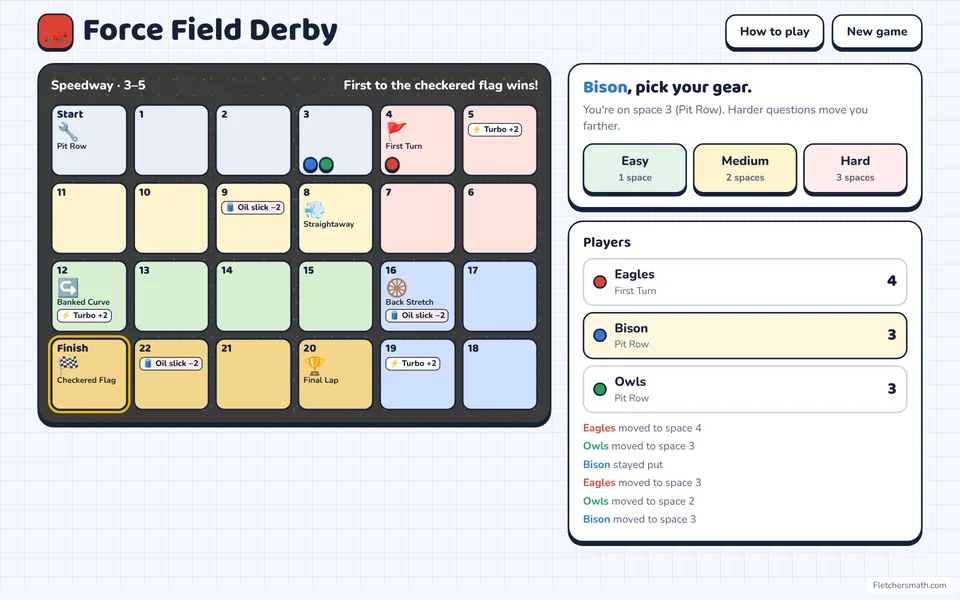
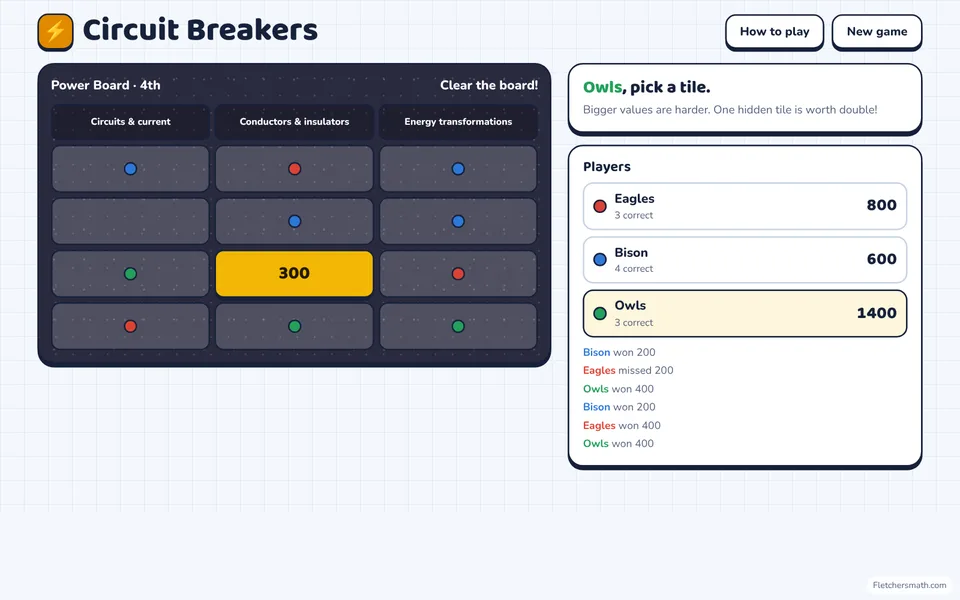
- Physical science: Force Field Derby (forces, Newton's laws and energy) and Circuit Breakers (circuits, conductors and Ohm's law).
- Chemistry: Periodic Table Heist (atoms, bonding and balancing equations).
- Science practices: Data Lab (variables, fair tests and claims backed by data) and Design Lab (the engineering design process).
- Unit and test review: Turf Takeover review games for each grade and course, like Turf Takeover: Middle School Life Science Review.
See all the math and science games, or browse by standard to find a game for the unit you're teaching.
Common questions
Are the science games aligned to NGSS?
Yes. Each Fletcher Math science game lists the NGSS performance expectations it practices on its game page.
Can I use science games without student devices?
Yes. The games are built for one shared screen, so the whole class can play in teams on a smartboard or projector.