Can Team Games Without Internet or Logins Teach to the Standards?
Teachers are asked to show that class time practices the standards. A game that needs no WiFi and no accounts is easy to run, but it only earns its place if you can point to the standards it covers.
Short answer: yes. Whether a game supports standards-aligned learning depends on what students actually do in it, not on whether it's online or has student accounts. A team game that runs offline with no logins can practice specific standards just as well as a web platform, as long as the problems are written to those standards, the game says which ones, and you can match it to the unit you're teaching.
What "standards-aligned" should mean in a game
- It names the standards. You should be able to see the exact codes (Common Core, Oklahoma Academic Standards, NGSS) before class, not a vague "grade 6 math" label.
- The math is the move. Students advance by solving problems on those standards, not by answering one question and then playing an unrelated mini-game.
- The level matches the grade. A grade picker or Easy, Medium and Hard problems let one game fit the students in front of you.
- You can place it in your pacing. A game that maps to a unit is a game you'll actually use in that unit.
What going offline and login-free changes
| Offline, no logins | Online with accounts | |
|---|---|---|
| Standards coverage | Depends on the game's problems | Depends on the game's problems |
| Time to start | Open the file and press Start | Sign-ins, passwords, rosters |
| Bad WiFi or blocked sites | No effect | Can stop the lesson |
| Student data | None collected | Accounts to review and protect |
| Individual progress reports | What you see during play | Saved per student |
The one real trade-off is saved per-student data. In a team game you get that evidence a different way: you hear it. When a team has to agree on an answer, the reasoning gets said out loud, and a misconception shows up the moment someone defends it.
How to use one in a standards-based unit
- Match the game to the standard you're on. Check the game's standards list against this week's objective.
- Teach first, then play. Games work best as practice and review once students have seen the skill.
- Listen while teams talk. Jot down which problems cause arguments. Those are your reteach targets.
- Close with one question. A quick exit ticket on the same standard shows whether the practice stuck.
Examples from Fletcher Math
Every downloadable Fletcher Math game is a single file that runs offline on one shared screen, with no student logins, for 1 to 6 players or teams. Each game page lists the standards it practices.
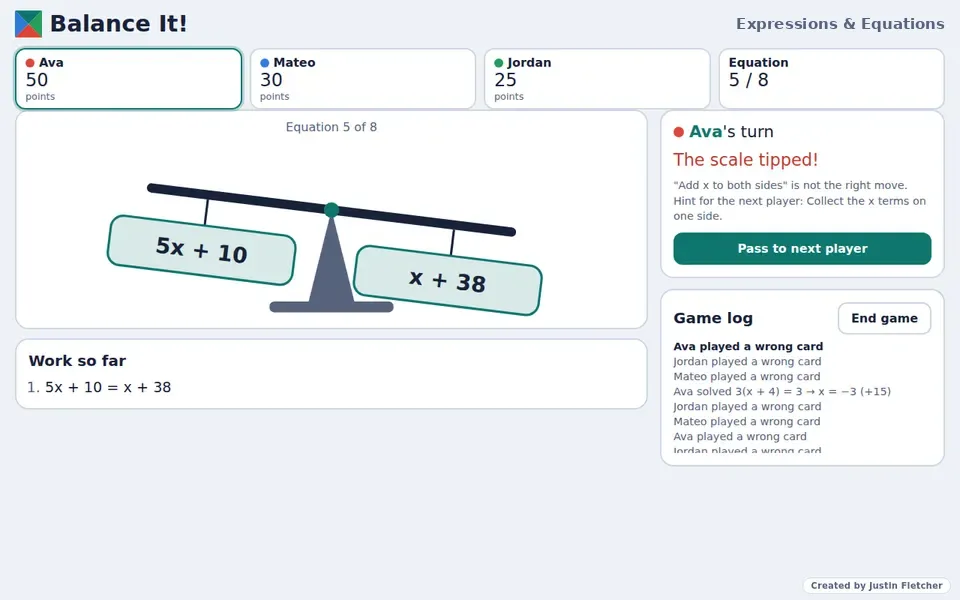
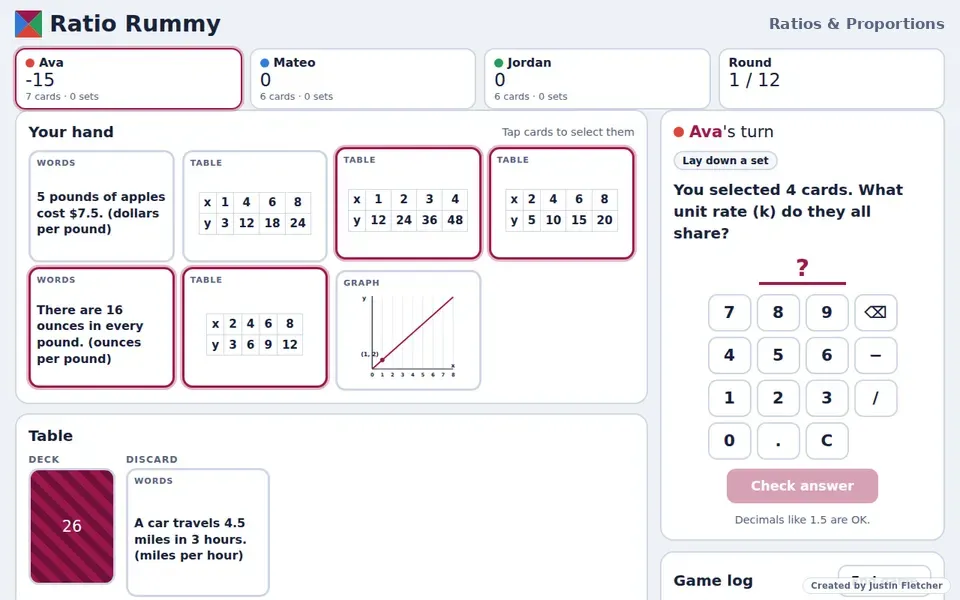
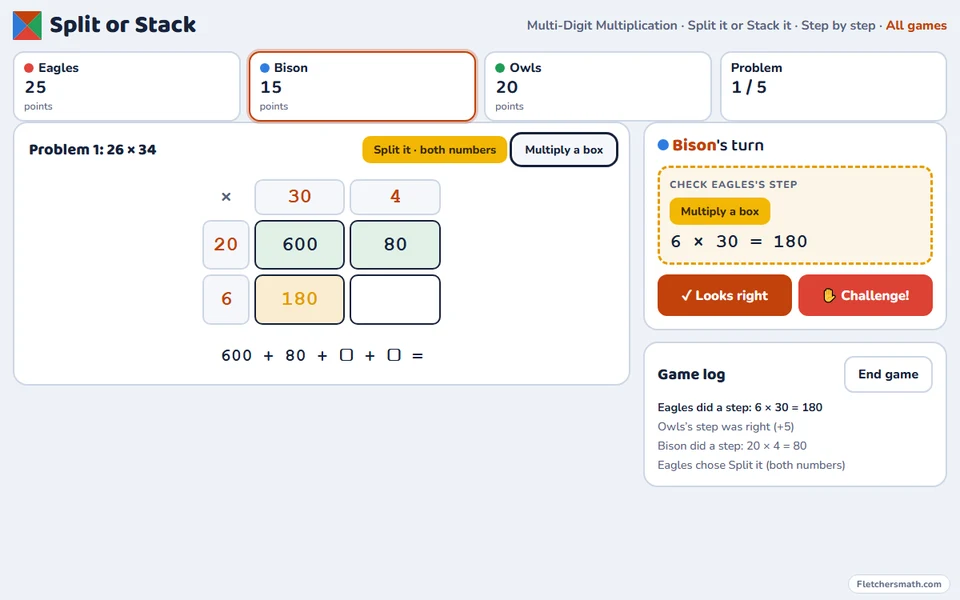
- Unit practice: Balance It! for solving equations in grades 7–8, Ratio Rummy for unit rates and proportional relationships, and Split or Stack for multi-digit multiplication.
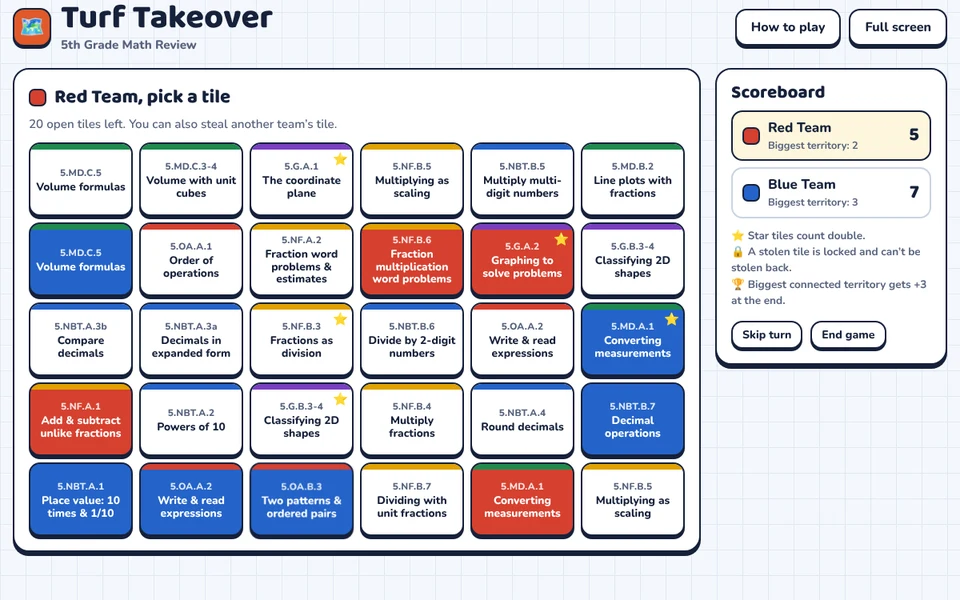
- Whole-year review: the Turf Takeover review games cover every standard for a grade, like Turf Takeover: 5th Grade Math Review and Turf Takeover: 7th Grade Math Review, with teams claiming and stealing tiles.
- Science: Food Web Frenzy and Turf Takeover: Middle School Life Science Review are written to NGSS life science standards.
You can browse every game by standard, or see where each game fits in the year on the curriculum guide.
Common questions
Do offline games still list the standards they cover?
They should. Every Fletcher Math game page lists its standards (Common Core, Oklahoma Academic Standards, or NGSS for science), and you can browse the games by standard.
How do I show progress without student accounts?
Use what you see and hear during team play, then give a short exit ticket on the same standard. That gives you a record without collecting student data in the game.