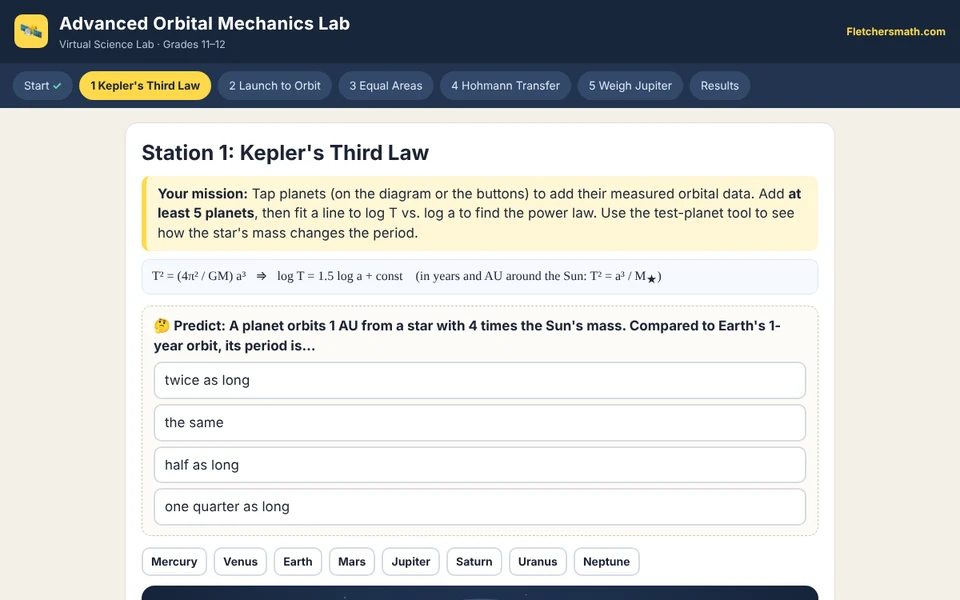
Grades 11–12 · Earth & Space
Advanced Orbital Mechanics Lab
Students test Kepler’s laws, launch satellites, plan a Hohmann transfer and measure Jupiter’s mass from its moons.
20 multiplayer classroom games and 12 virtual labs that practice earth & space skills, for Kindergarten, 1st Grade, 2nd Grade, 3rd Grade, 4th Grade, 5th Grade and more. The games play on one shared screen and the labs run on each student's device. No student logins, works offline, and every one has a free demo you can try right now.
Students test Kepler’s laws, launch satellites, plan a Hohmann transfer and measure Jupiter’s mass from its moons.
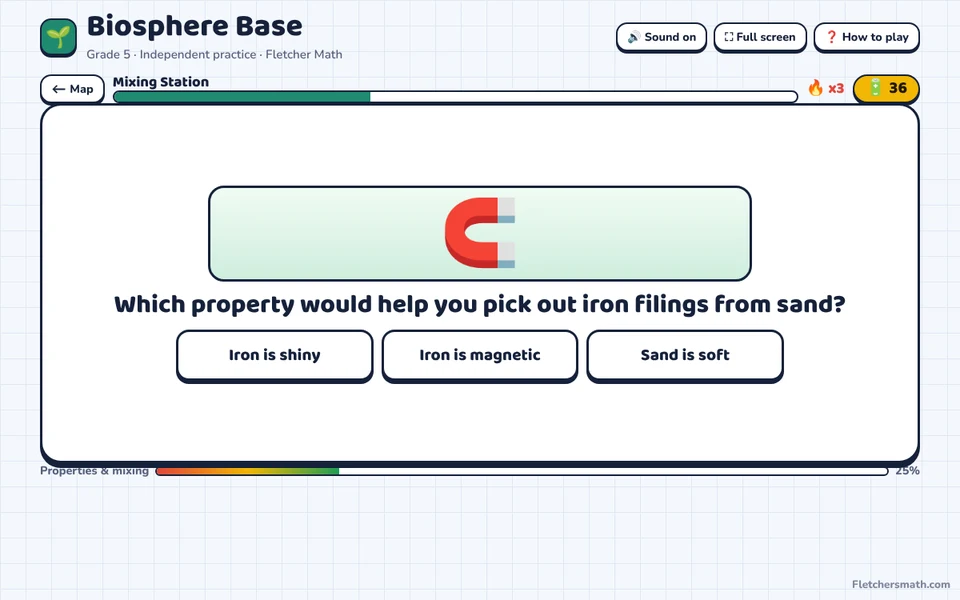
A single-player science game for 5th grade. Run a science station: conservation of matter, mixtures and new substances, food webs and decomposers, gravity, shadows and star patterns, and Earth's spheres, then finish with a skills report for six 5th grade NGSS standards.
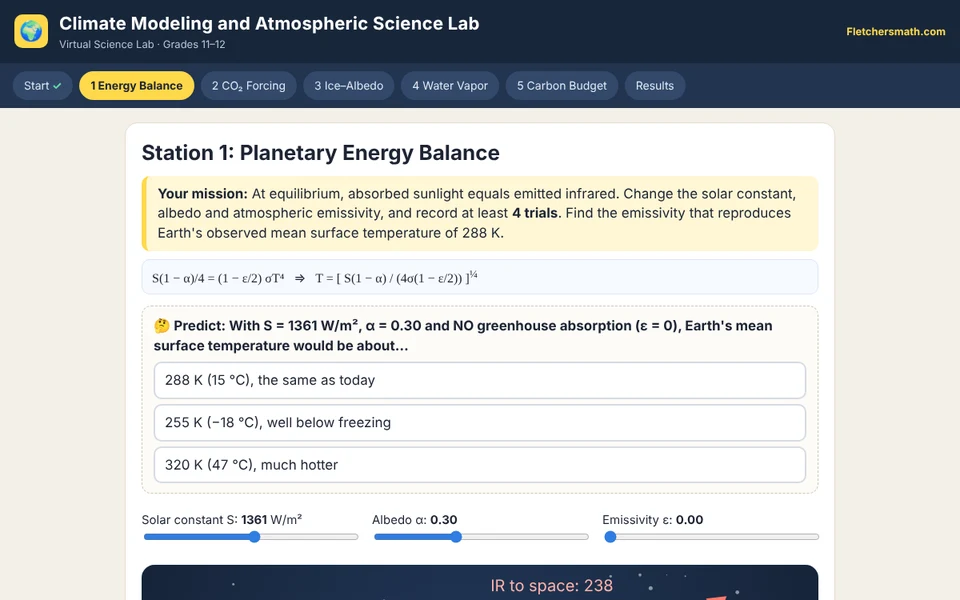
Students build an energy balance model, measure CO₂ forcing, find an ice–albedo tipping point and test a carbon budget.
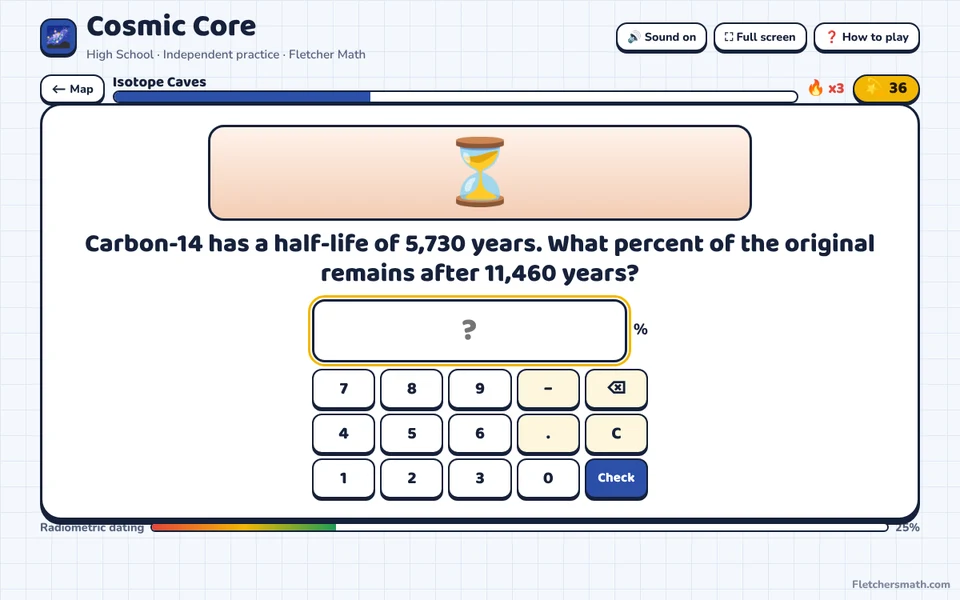
A single-player Earth and space science game for high school. Explain plate tectonics, date rocks with half-lives, trace how life and Earth changed together, read climate evidence, follow the lives of stars, use Big Bang evidence and apply Kepler's laws, then finish with a skills report for seven NGSS Earth and space standards.
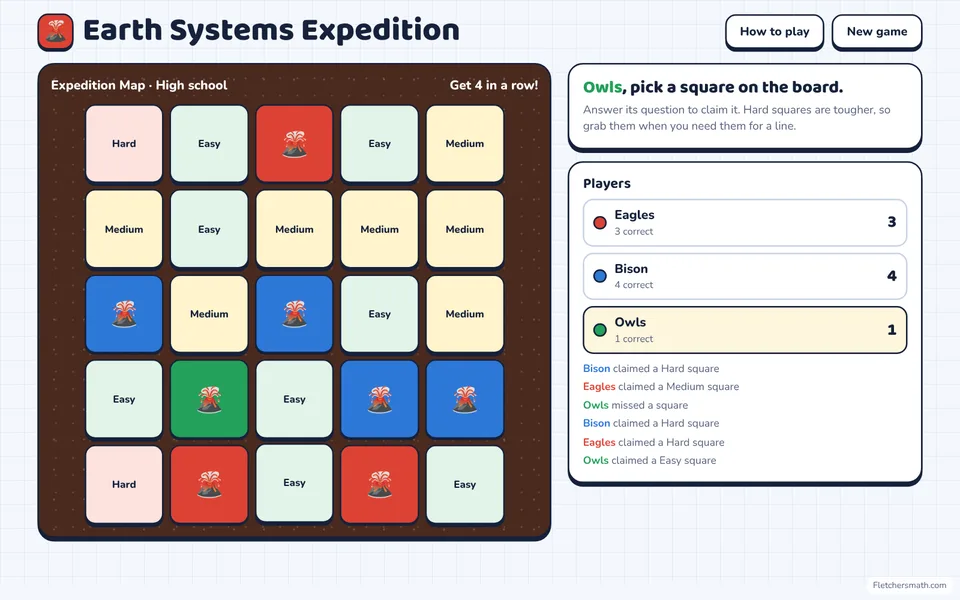
Plate tectonics, Earth’s interior, the water and carbon cycles, climate feedbacks, resources and sustainability.
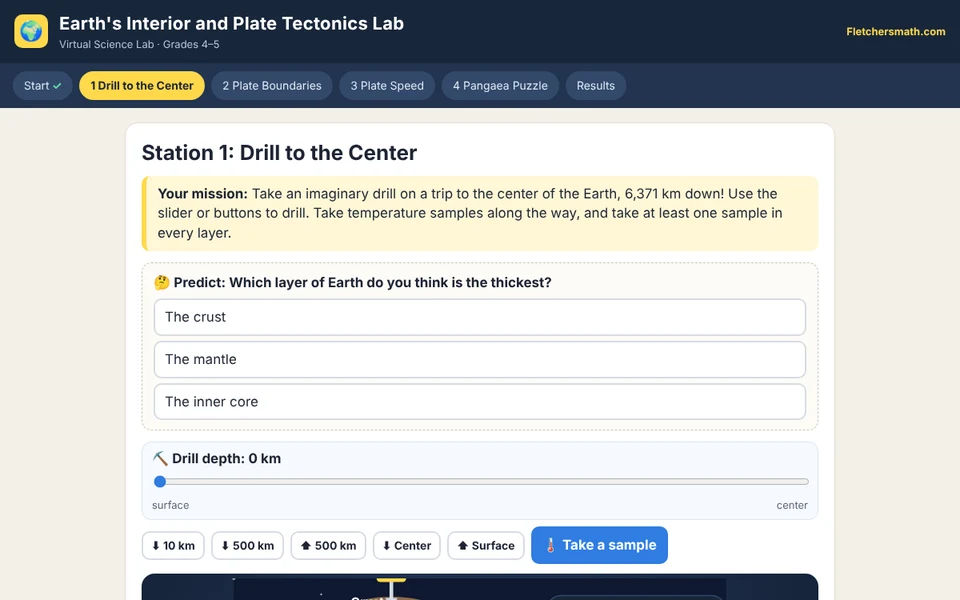
Students drill to Earth's center, watch plate boundaries over time, measure plate speed and fit Pangaea back together.
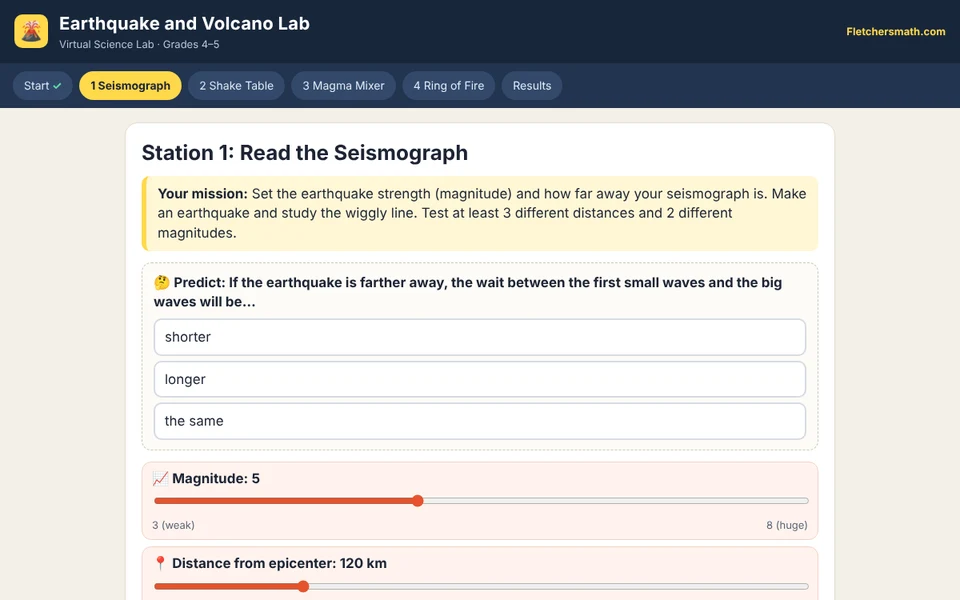
Students read seismographs, test buildings on a shake table, mix magma to build volcanoes and map the Ring of Fire.
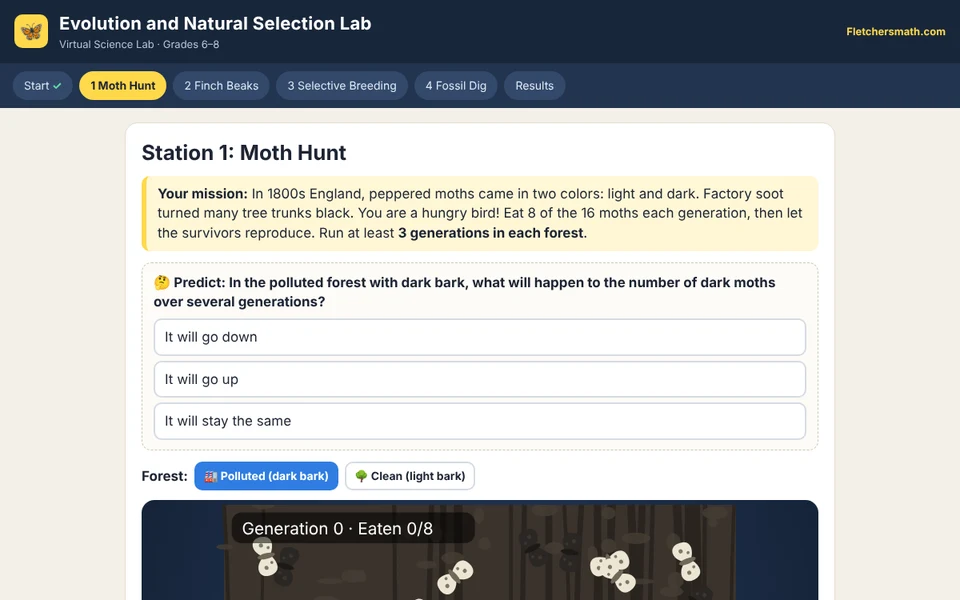
Students hunt peppered moths, track finch beaks through droughts, breed corn from teosinte and dig up whale fossils.
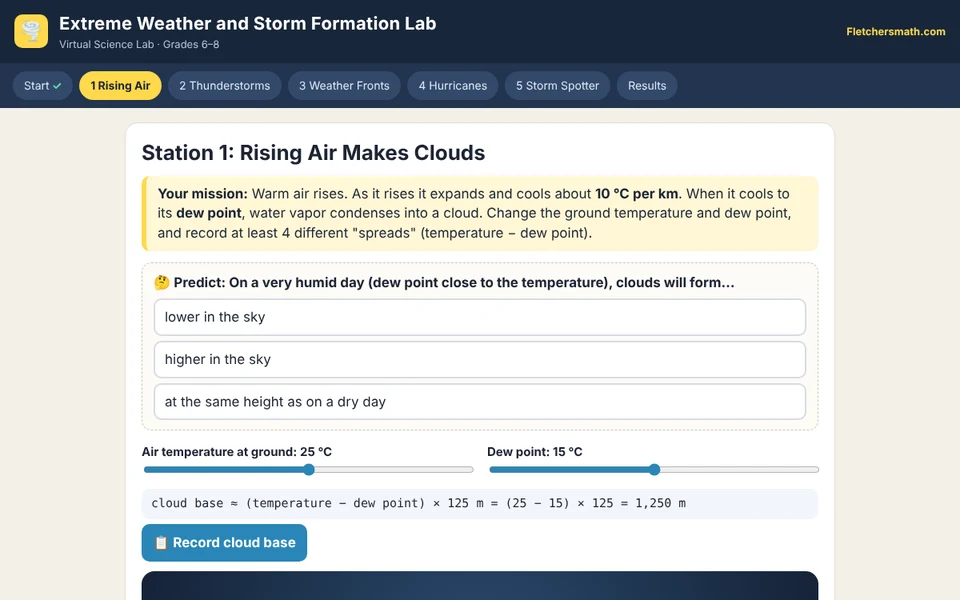
Students lift air to make clouds, build thunderstorms, move fronts, fuel hurricanes and time lightning.
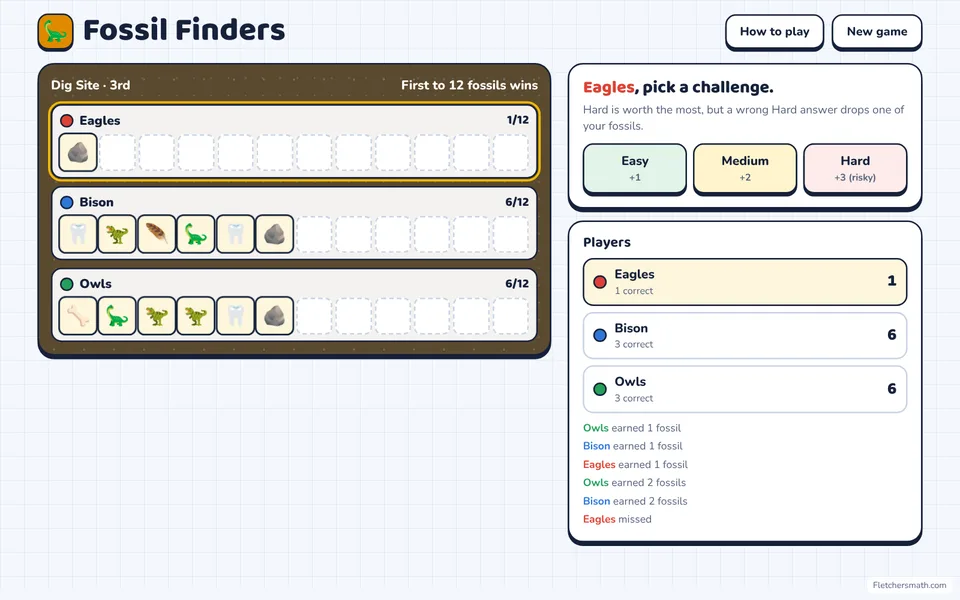
Life cycles, fossils, rock layers and evidence of evolution. Dig up the most fossils.
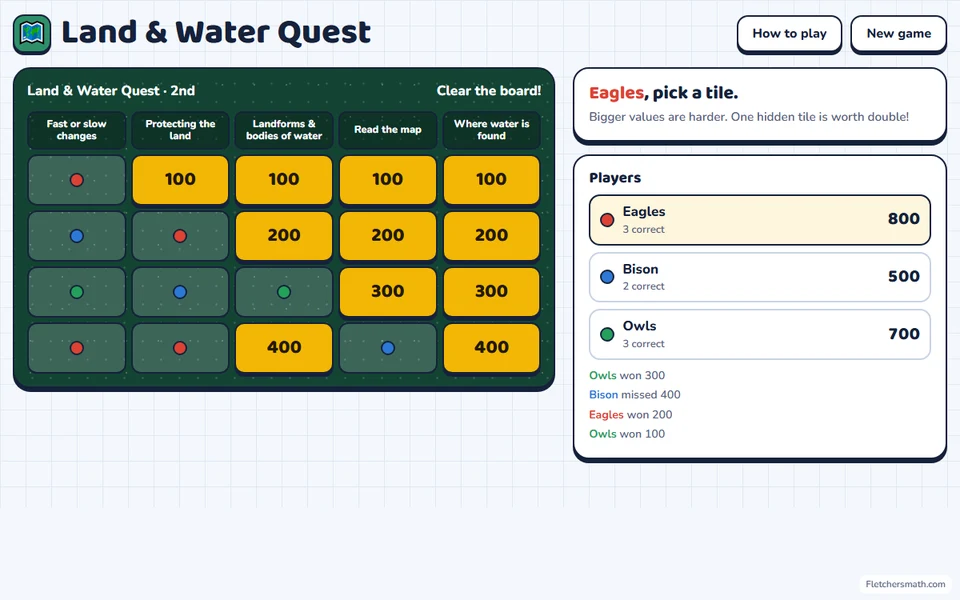
A 2nd grade Earth science game show: fast and slow changes, protecting land from wind and water, landforms and bodies of water, map reading and where water is found.
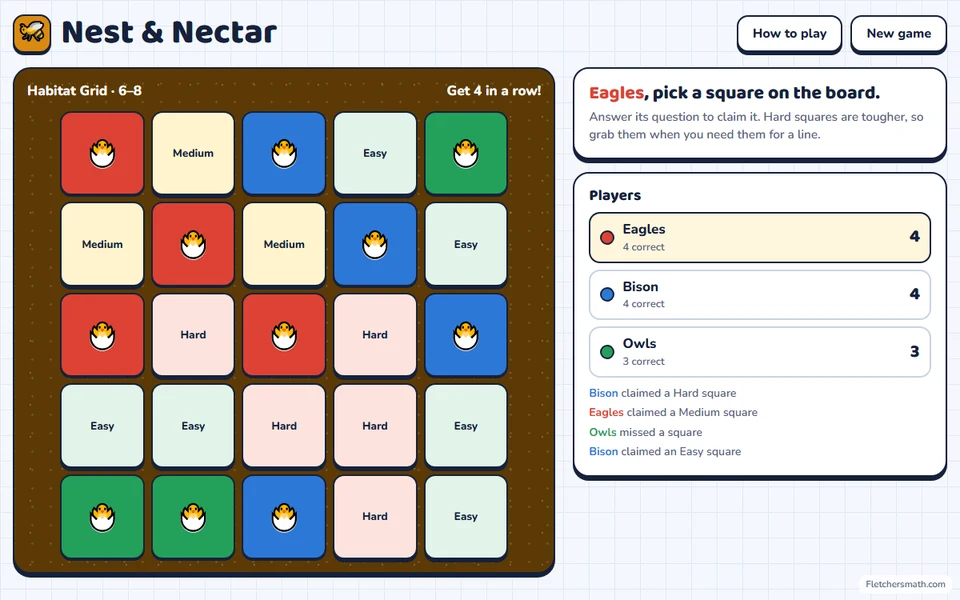
Claim squares by explaining how animal behaviors and plant structures increase the odds of reproduction, how animals help plants and how environment and genes affect growth. Get 4 in a row to win.
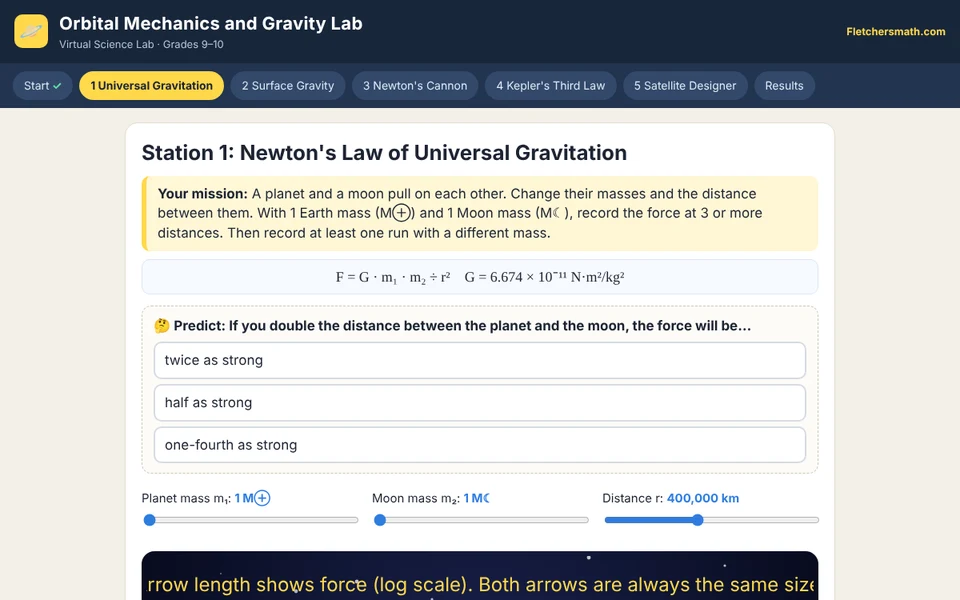
Students measure gravity, fire Newton's cannon into orbit, test Kepler's third law and find a geostationary altitude.
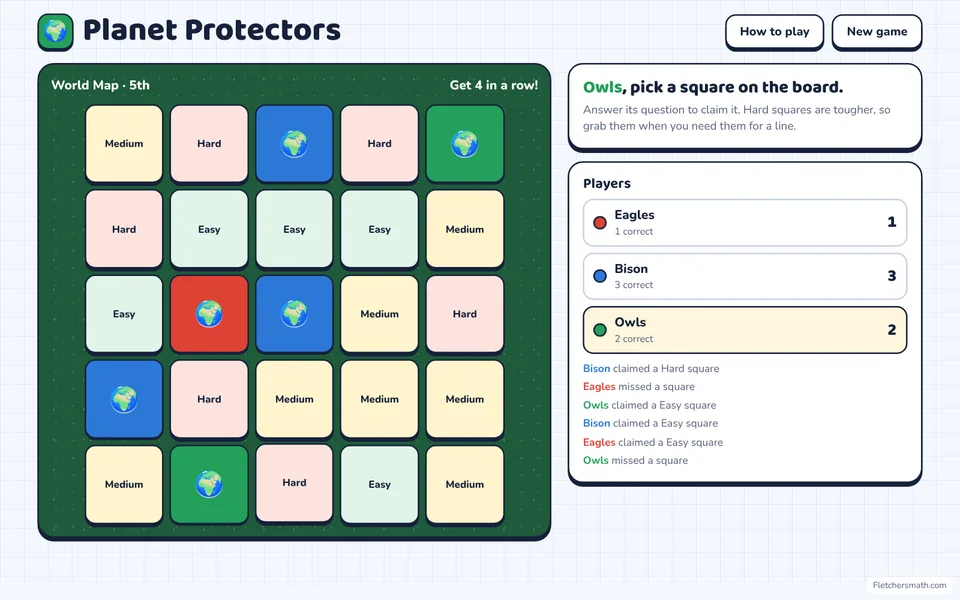
Natural resources, hazards, human impact and climate. Protect four regions in a row.
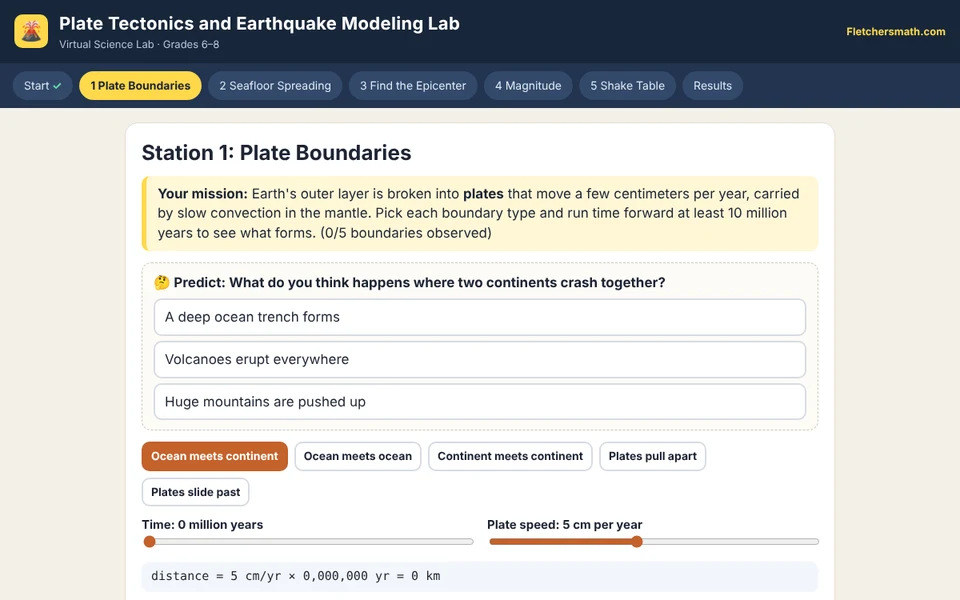
Students model plate boundaries, date the seafloor, locate an epicenter, compare magnitudes and test buildings.
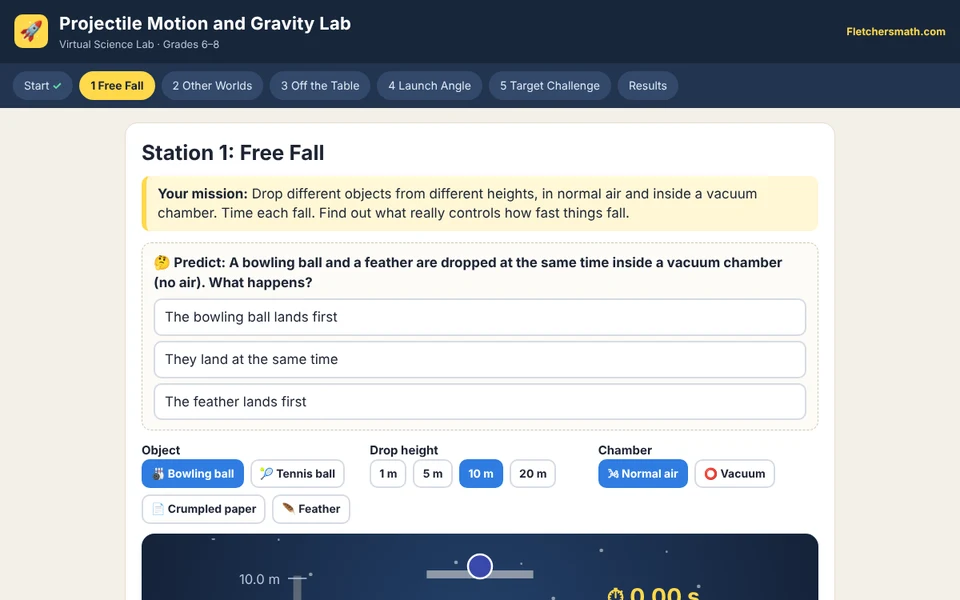
Students drop objects in air and vacuum, test gravity on other worlds, launch at angles and hit targets.
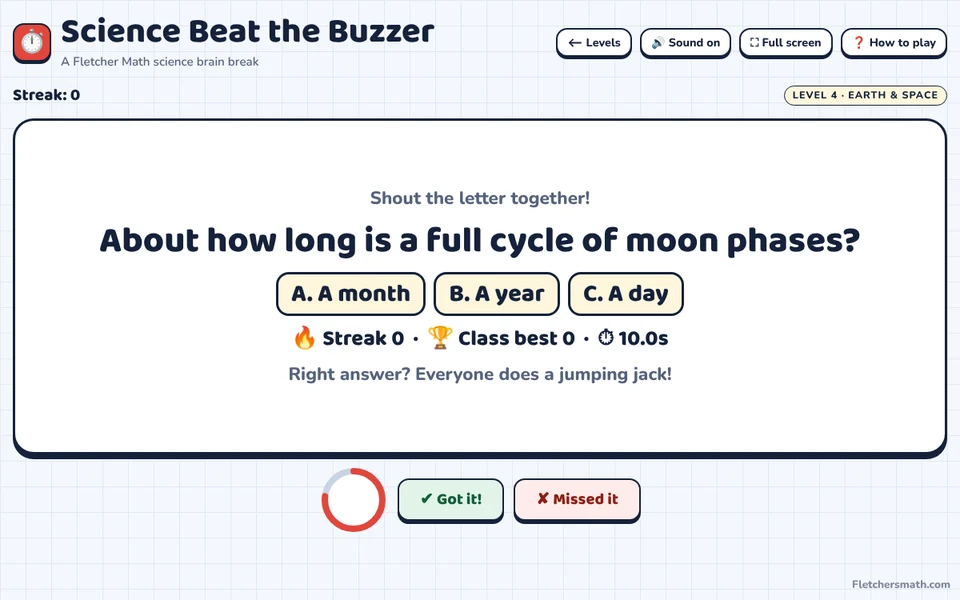
The class shouts the letter of the right answer to build a streak before the buzzer. Every right answer makes the clock a little faster.
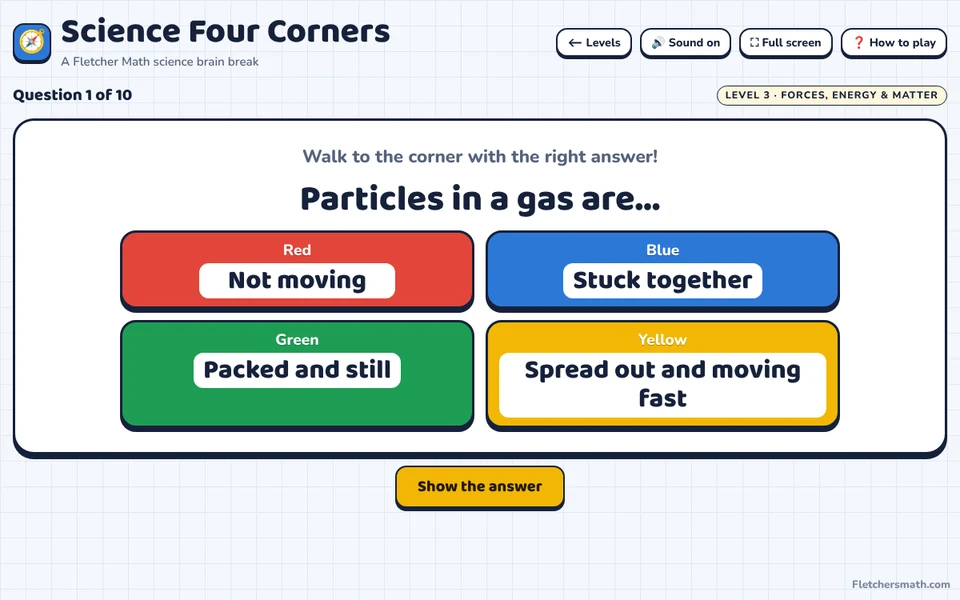
A science question appears with four answers, one for each corner of the room. Students walk to the corner they think is right, then the answer lights up.
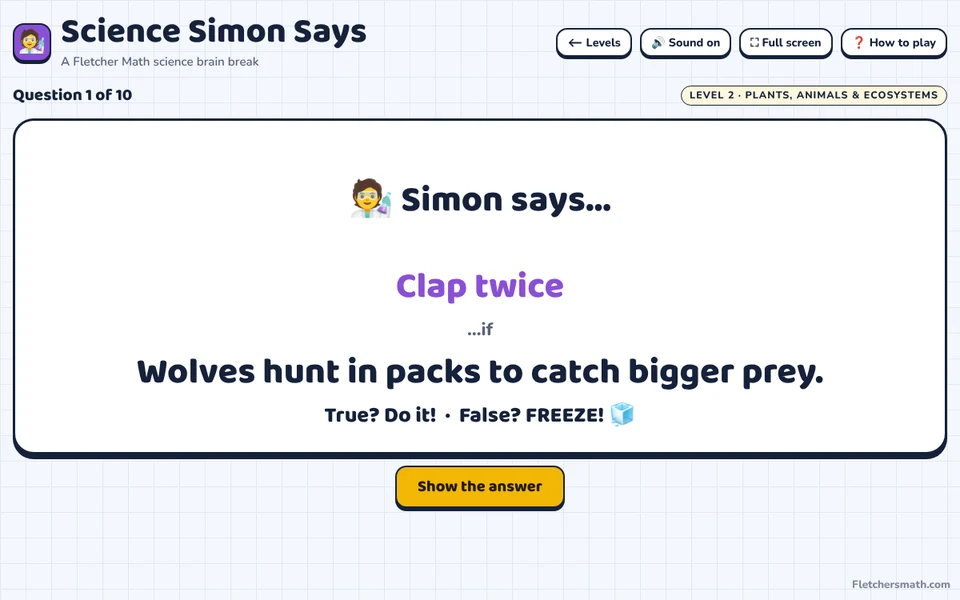
Simon says buzz like a bee if plants need sunlight to grow! Students do the move only when Simon says it and the science is true.
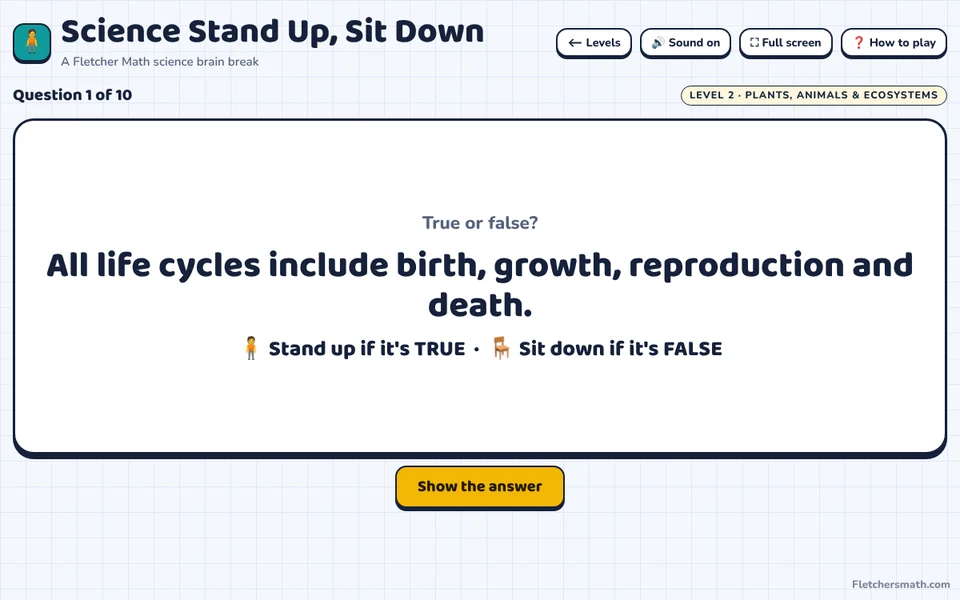
A science statement appears on the screen. Students stand up if it's true and sit down if it's false, then the answer and the real science pop up.
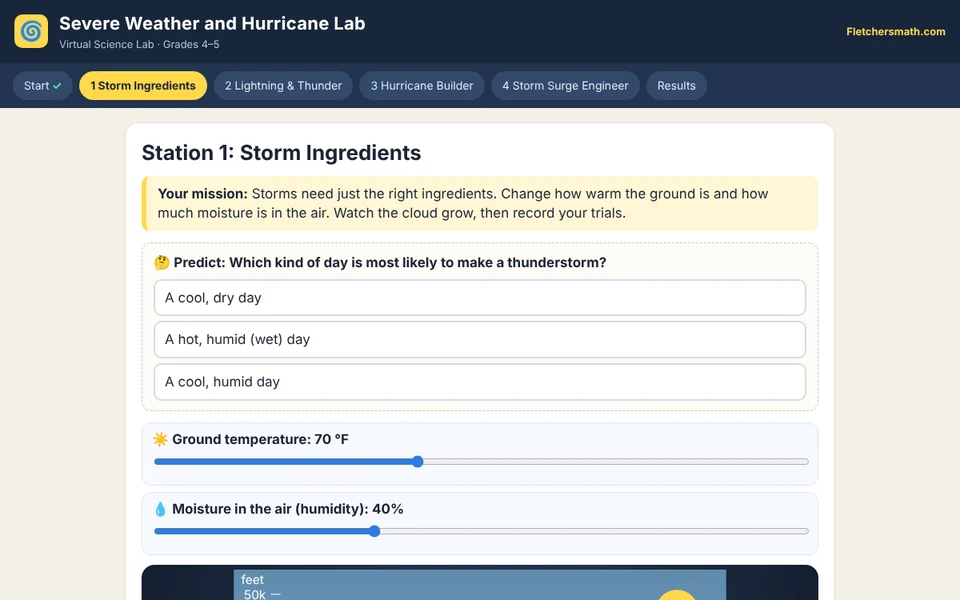
Students build storms, time lightning to find its distance, power up hurricanes and design homes that stay dry.
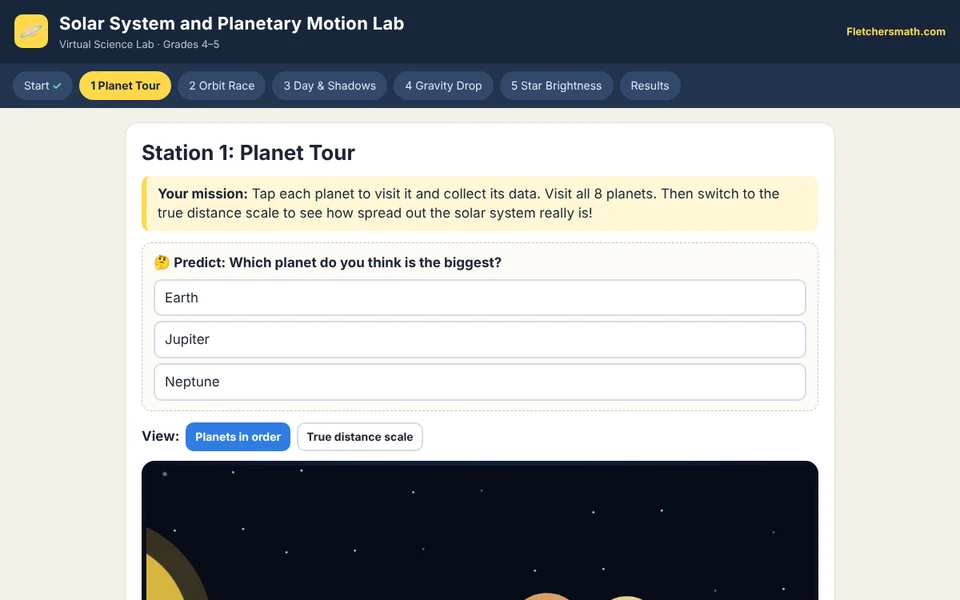
Students tour planets, race orbits, track shadows, drop balls on other worlds and measure star brightness.
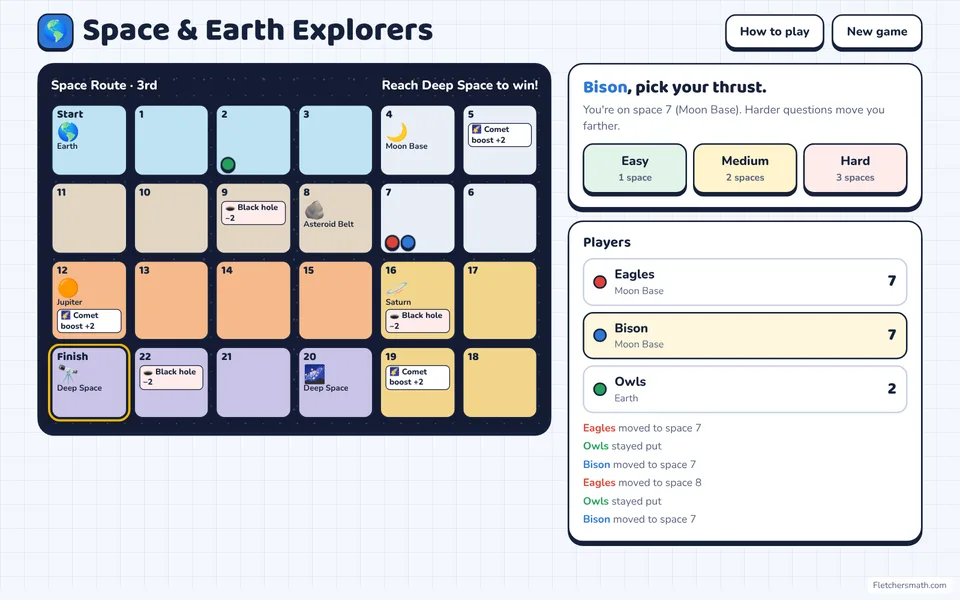
Weather and climate, rocks and fossils, erosion, the sun, moon and stars on a trip across the solar system.
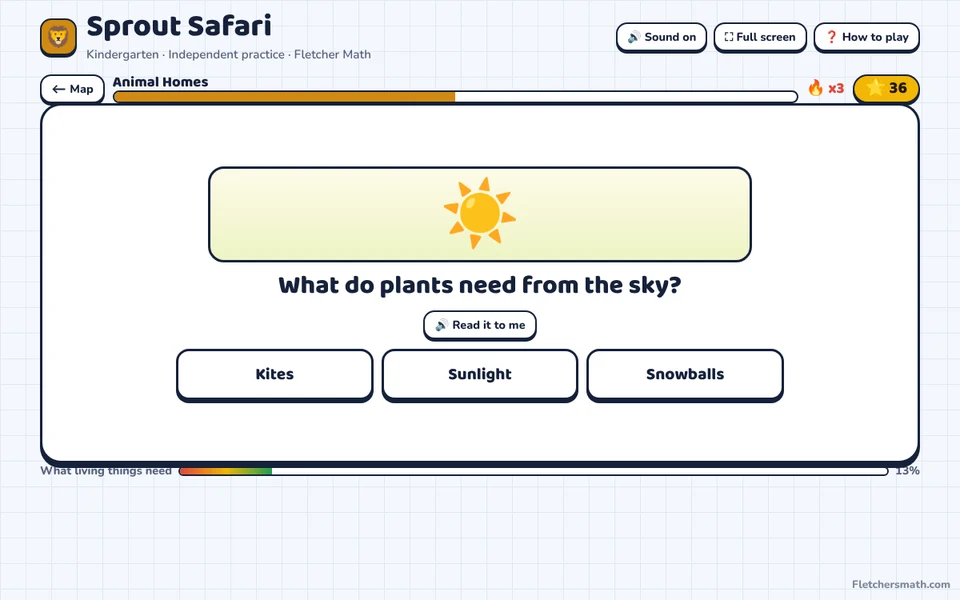
A single-player picture science game for kindergarten. Every question is read aloud: what living things need, where they live, pushes and pulls, sun and shade, weather, and caring for Earth. Finish with a skills report for six kindergarten NGSS standards.
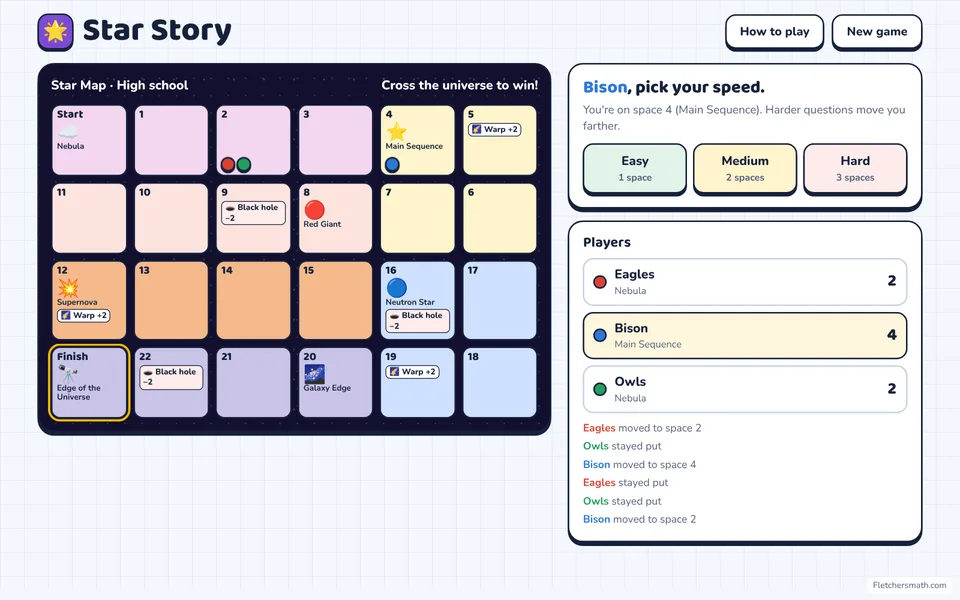
Fusion, the life of stars, the Big Bang, how elements form, orbits and Earth’s early history. Travel across the universe.
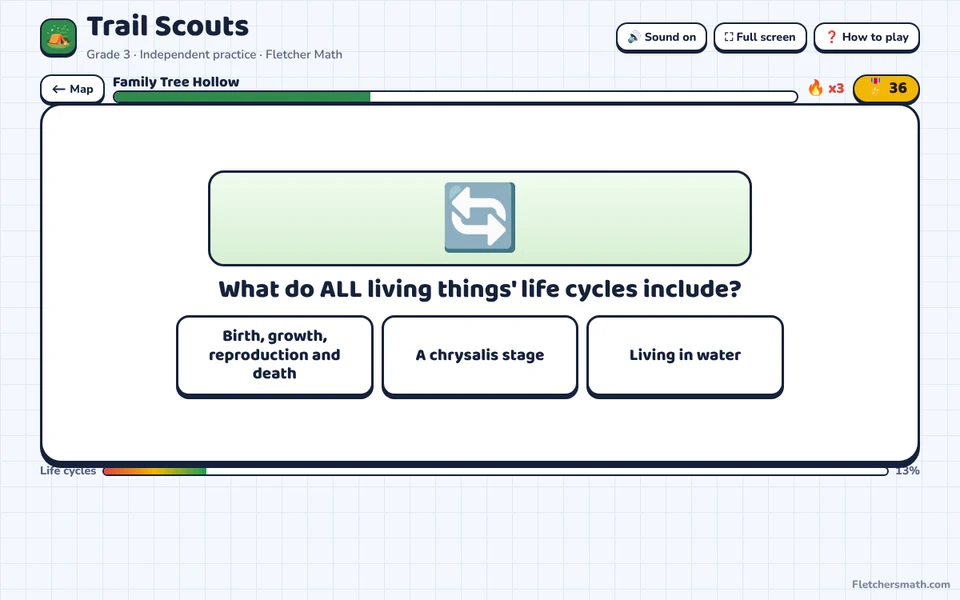
A single-player science game for 3rd grade. Hike two trails earning scout badges for life cycles, inherited traits, adaptations, balanced forces, magnets and weather, beat the trail bosses, and finish with a skills report for six 3rd grade NGSS standards.
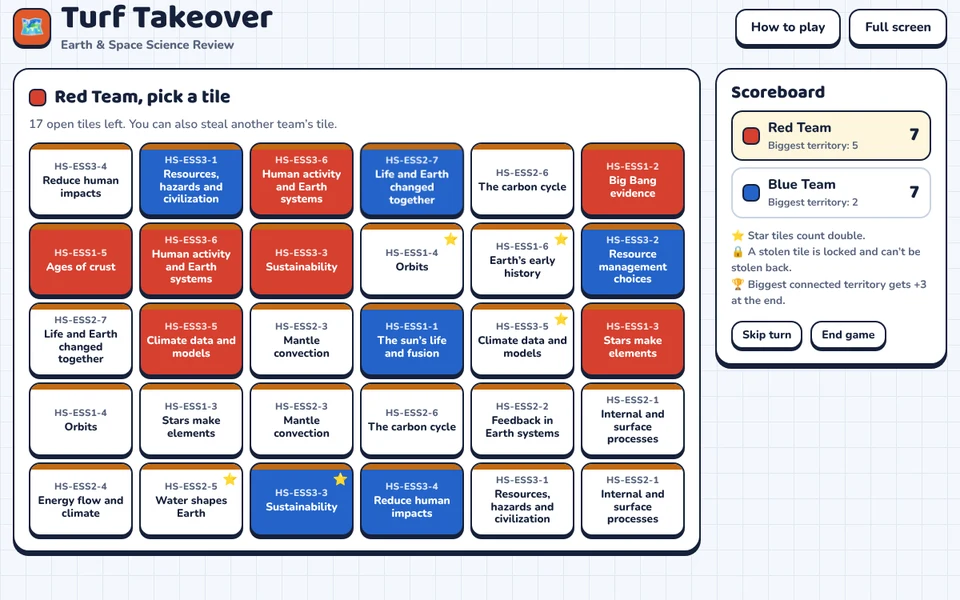
A team review game for every NGSS Earth & Space Science standard. Teams claim tiles on a map by answering questions, and can steal each other's tiles. Play a full review or pick the standards you want. The results show % correct for each standard.
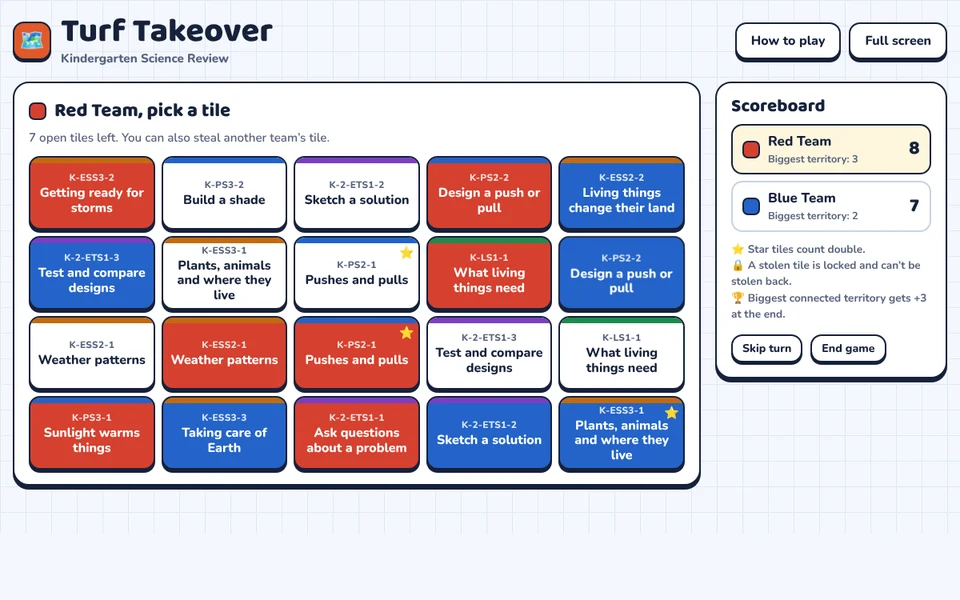
A team review game for every NGSS kindergarten science standard. Teams claim tiles on a map by answering questions, and can steal each other's tiles. Play a full review or pick the standards you want. The results show % correct for each standard.
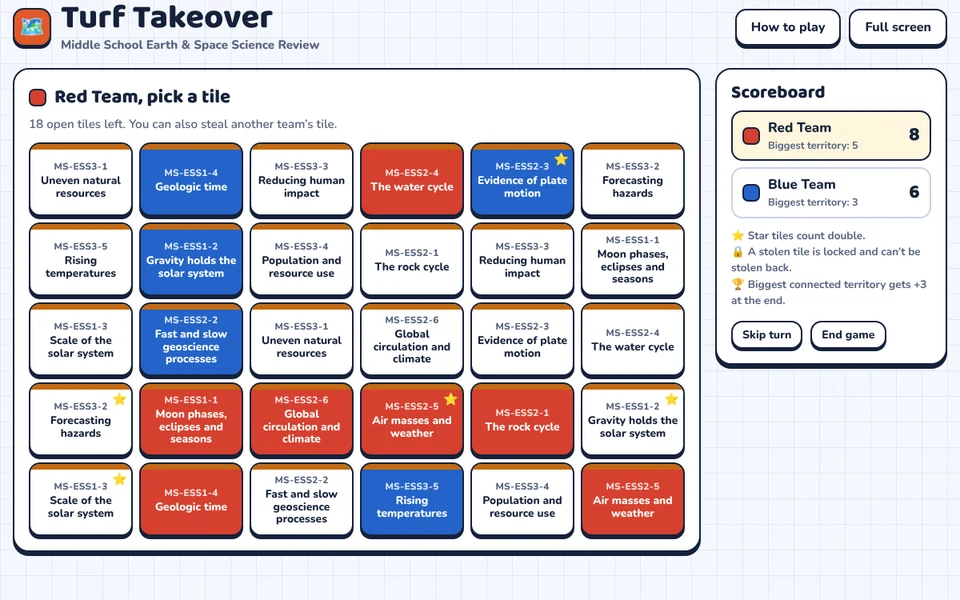
A team review game for every NGSS middle school earth & space science standard. Teams claim tiles on a map by answering questions, and can steal each other's tiles. Play a full review or pick the standards you want. The results show % correct for each standard.
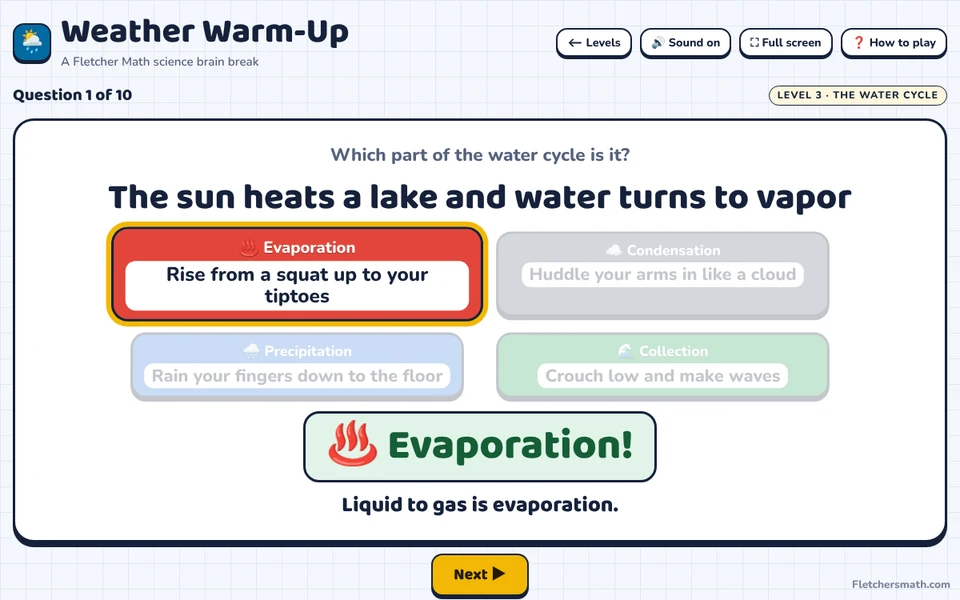
A weather card appears. Students act out sunny, rainy, windy or snowy, the water cycle, weather tools or weather fronts.
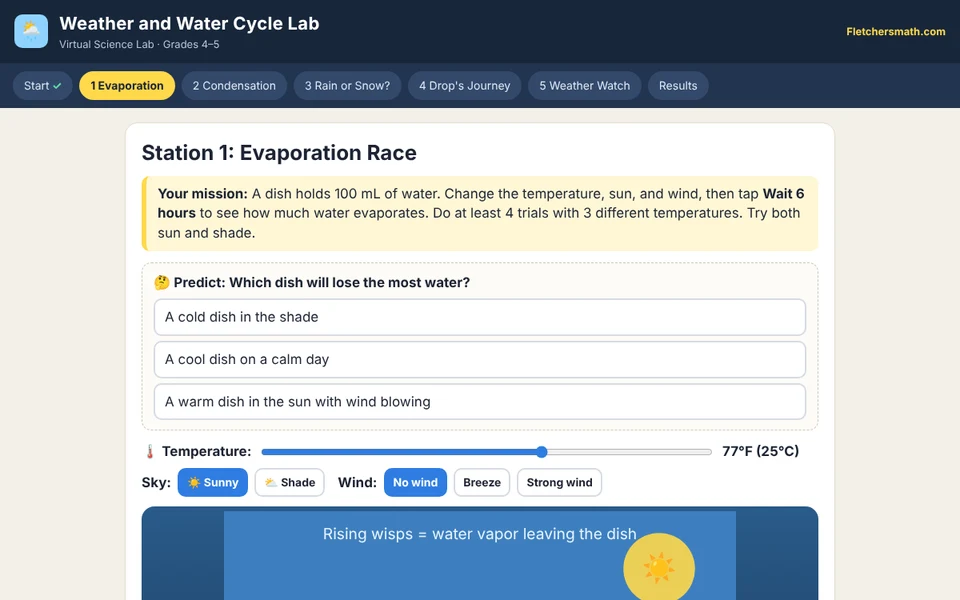
Students test evaporation and condensation, find four kinds of precipitation and forecast a week of weather.
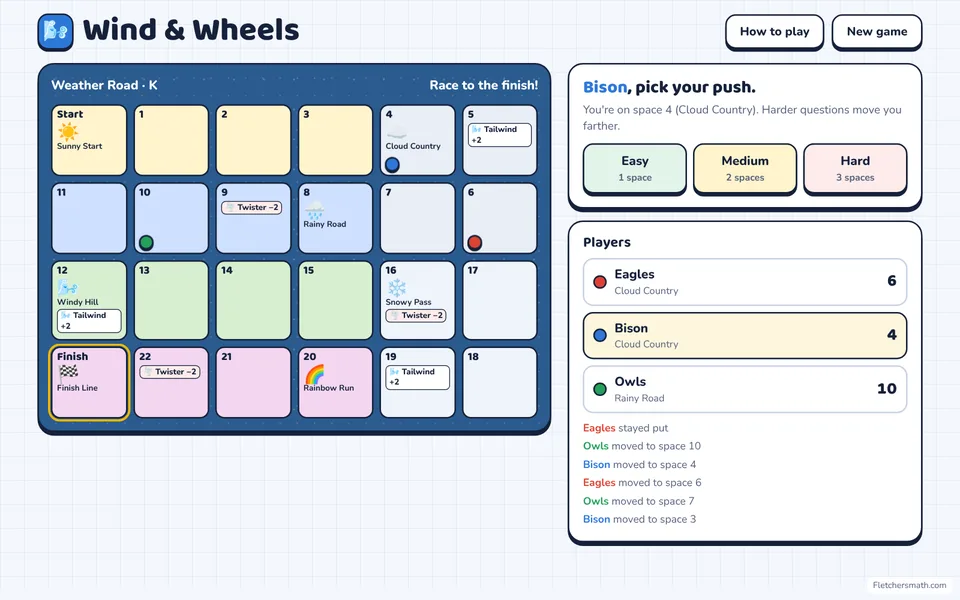
Weather, seasons, pushes and pulls, and building materials on a windy road race.
The All-Access Teacher License includes every game, every grade and all future games.